|
DANIEL W. BROMLEY Anderson-Bascom Professor of Applied Economics (Emeritus) University of Wisconsin-Madison |
|

My research concerns the institutional foundations of economic systems. Institutions constitute the legal architecture of markets and of market processes. All economies are constituted (defined) by their legal structures that give specific content to market processes. I am interested in the existing institutional arrangements, and in the process of institutional change. Below I describe four recent books that reflect this emphasis on the institutional foundations of economic systems, how those institutional arrangements serve to structure human behaviors, and how public policy must be understood as a quest for reason giving.
Below I describe four of my recent books. I also provide a link to an abbreviated version of my C.V. as well as links to four journal articles that may be of interest.
RECENT BOOKS
POSSESSIVE INDIVIDUALISM: A CRISIS OF CAPITALISM, Oxford University Press, 2019.
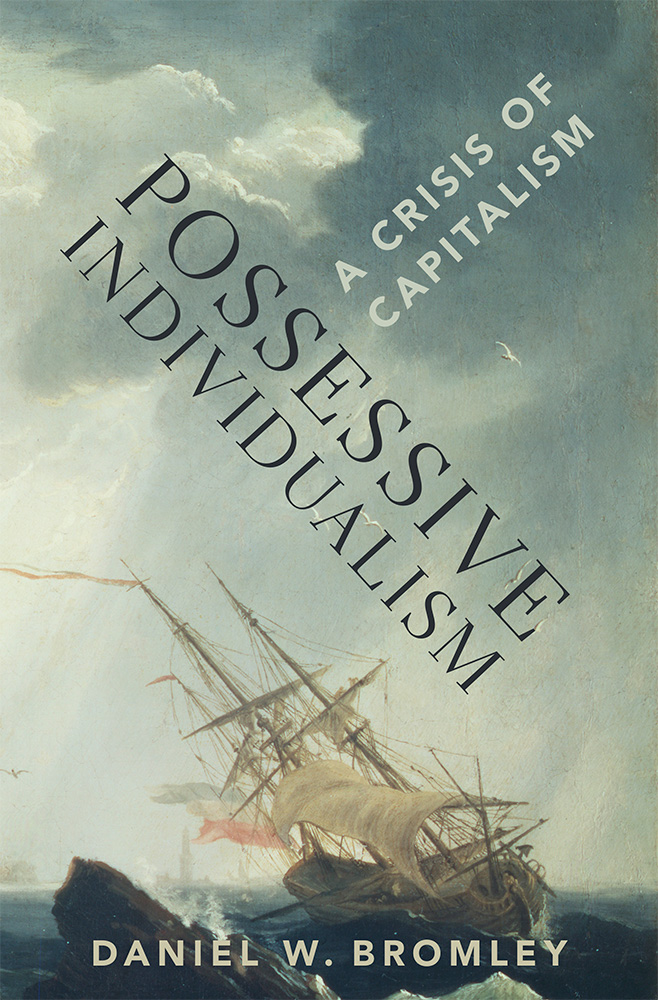
Anxiety and alienation threaten modern democracies. Political anger runs rampant in the United States, Britain wants to leave the European Union, authoritarian governments control several European countries, and millions of desperate migrants are streaming north out of the Middle East, Africa, and Latin America. Many people blame stagnant household incomes and economic inequality. However, Possessive Individualism argues that the origins of world disorder are in the failure of the Enlightenment to anticipate the acquisitive individual as a creature of global capitalism.
In this book I provide a critique of contemporary capitalism to explain why the world now finds itself in widespread disorder. Capitalism's basic flaw is 'possessive individualism.' Glorification of the rational individual, motivated by acquisitiveness, prevents the adoption of necessary government programs that would ease the economic burden on beleaguered households. Meanwhile, possessive individualism enables managerial capitalism to suppress wages and salaries, embrace automation, and move jobs overseas. Capitalism is no longer an engine of improved livelihoods and social hope.
Drawing on evolutionary institutional economics and political theory, this book offers two remedies to the crisis of modern capitalism. Escape from the crisis requires that the isolated acquisitive individual rediscovers a sense of loyalty to others as neighbors, as colleagues, and as participants in the shared social process of living.
Escape also requires that the private firm be reimagined as a public trust in which the economic well-being of employees becomes a central part of its purpose. In the absence of these dual transformations, capitalism as we know it cannot endure.
ENVIRONMENTAL HERESIES: THE QUEST FOR REASONABLE, Palgrave Macmillan, 2016. (with Juha Hiedanp )

In this book, we deconstruct the pervasive and counter-productive discourse surrounding environmental policy. We argue that environmental policy problems are always framed such that conflict is inevitable: a particular project or policy must be accepted versus a specific environmental asset that must be protected. Over the course of 12 chapters, we demonstrate that confident yet contradictory assertions by contending interests preclude necessary deliberation and reason giving. We argue that deliberation is an important social process of reflecting upon the reasons for doing something. Our approach allows discourse and collaboration to continue, until after honest and informed deliberation, the better way forward is arrived at. This approach to environmental policy illustrates just how very constructive and enabling the quest for the reasonable can be.
VULNERABLE PEOPLE, VULNERABLE STATES: REDEFINING THE DEVELOPMENT CHALLENGE, Routledge, 2012. (with Glen Anderson)
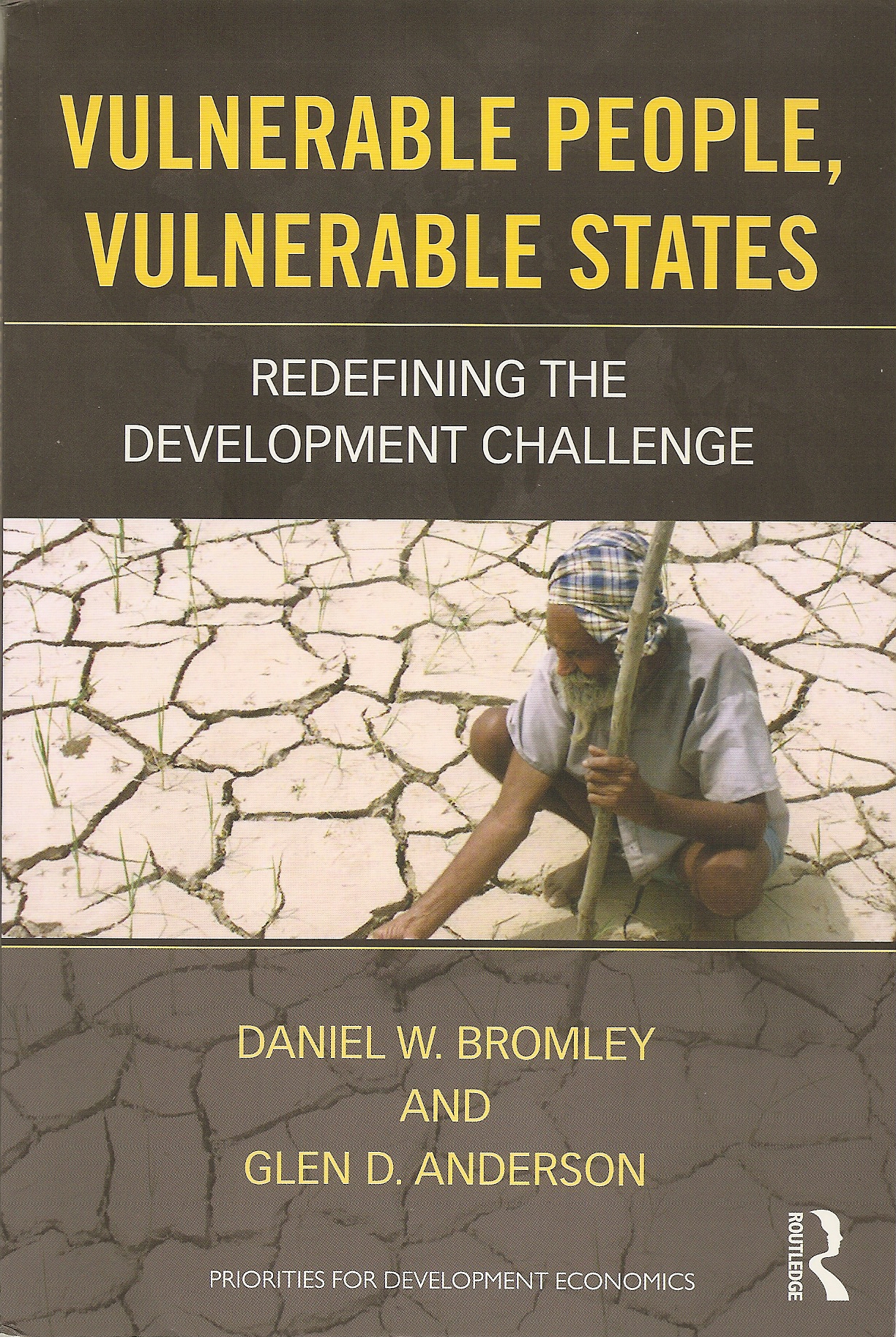
Over five decades of economic and technical assistance to the countries of Africa and the Middle East have failed to improve the life prospects for over 1.4 billion people who remain vulnerable. Billions of dollars have been spent on such assistance and yet little progress has been made. Persistent hunger and hopelessness threaten more than individuals and families. These conditions foster political alienation that can easily metastasize into hostility and aggression. Recent uprisings in the Middle East are emblematic of this problem. Vulnerable people give rise to vulnerable states.
We challenge the dominant catechism of development assistance by arguing that the focus on economic growth (and fighting poverty) has failed to bring about the promised convergence. Poor people and poor countries have clearly not closed the gap on the rich industrialized world. Pursuing convergence has been a failure. Here we argue that development assistance must be reconstituted to focus on creating economic coherence. People are vulnerable because the economies in which they are embedded do not cohere. The absence of economic coherence means that economic processes do not work as they must if individual initiative is to result in improved livelihoods. Weak and vulnerable states must be strengthened so that they can become partners in the process of creating economic coherence. When economies do not cohere, countries become breeding grounds for localized civil conflicts that often spill across national borders.
This book explains the necessary building blocks of economic coherence. It then develops a diagnostic approach to demonstrate how to identify impediments to the efficient functioning of essential economic processes. Finally, the book contains an extensive treatment of the policy-reform process, complete with a practical guide to how donors can work with governments to create economic coherence.
SUFFICIENT REASON: VOLITIONAL PRAGMATISM AND THE MEANING OF ECONOMIC INSTITUTIONS, Princeton University Press, 2006.
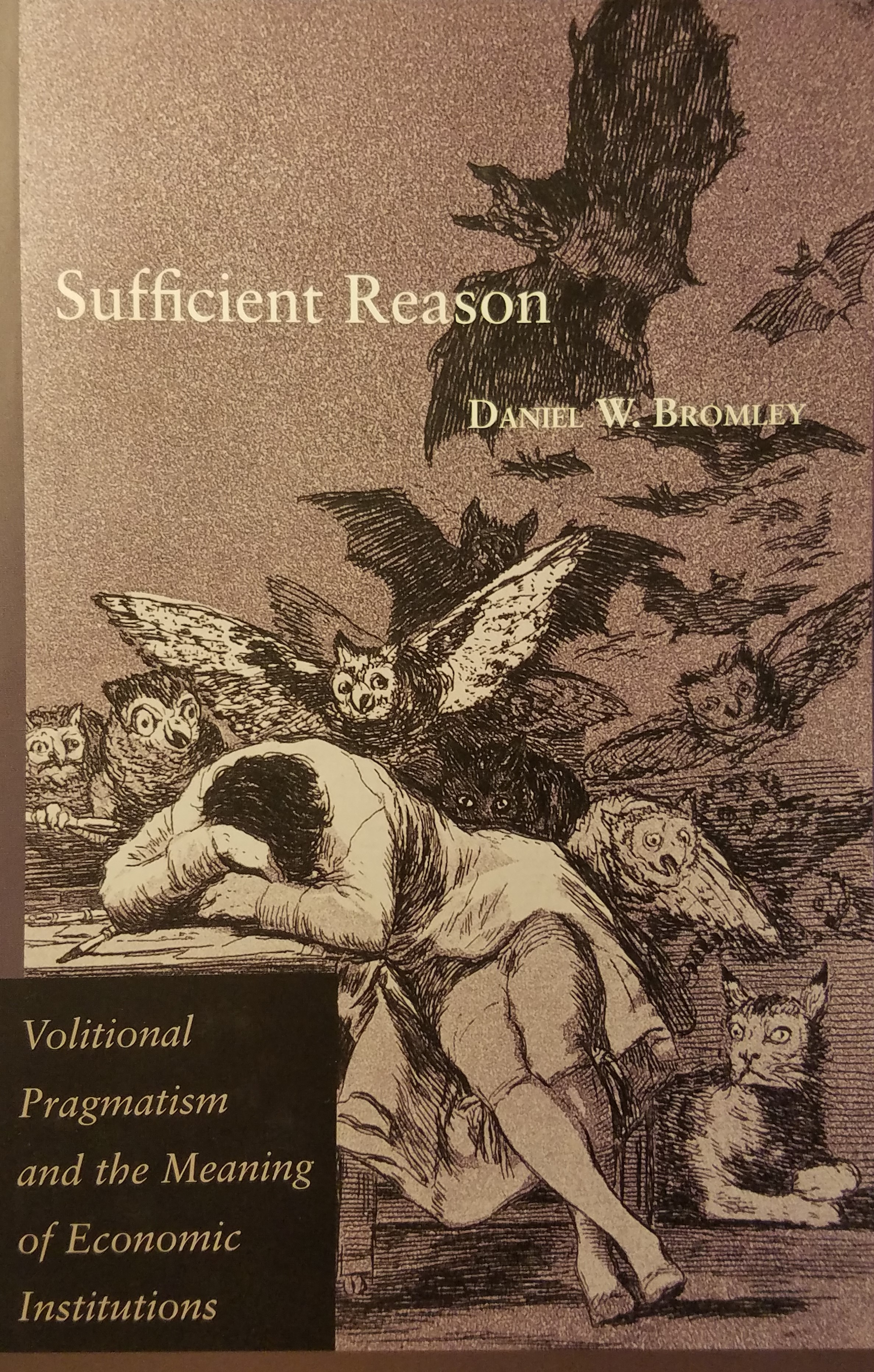
Economic institutions constitute the customary and legal foundations of the economy. Institutions comprise the behavioral architecture that defines the choice sets, the fields of action, for all participants in an economy. Economists, philosophers, historians, legal scholars, and sociologists hold starkly differing accounts of these institutions, and of the process of institutional change. In this book, I advance an original theory of institutions and of the process of institutional change. It is a theory that accommodates the conceptual richness of all the social sciences. I avoid the circularities of standard accounts that regard institutional change as the inevitable manifestation of power, or as the continual pursuit of efficiency.
Drawing on the works of John R. Commons, Thorstein Veblen, G.L.S. Shackle, John Dewey, Charles Sanders Peirce, and Richard Rorty, I develop a non-normative theory that brings necessary clarity and coherence to this important area of social science scholarship. Volitional pragmatism elaborates the idea of the human will in action, looking to the future, seeking ways to work out how we wish that future to unfold and then crafting the institutional arrangements that will plausibly bring that future about. This is not the mechanism of economic theories of institutional change, but is rather the volition of final cause--an outcome in the future for the sake of which particular actions today seem both necessary and sufficient. Institutional change is properly modeled, in democratic societies, as the quest for what seems better, at the moment, to do. Institutional change entails sufficient reason.
 PARTIAL C.V.

A FEW OTHER WORKS
(click on the button at left for a pdf version)
Volitional Pragmatism: The Collective Construction of Rules to Live By, The
Pluralist, 10(1):6-22.
Institutional
Economics, Journal of Economic Issues, 50(2):309-25, June 2016.
The French Revolution and German Industrialization: Dubious Models and Doubtful
Causality, Journal of Institutional Economics, March 2016 (with Michael
Kopsidis).
Where is the Backward Russian
Peasant? Evidence Against the Superiority of Private Farming, 1883 1913, Journal
of Peasant Studies, 42(2):425-47, 2015 (with Michael Kopsidis and Katja Bruish).
RETURN TO TOP OF PAGE